Whoa… been a while since I dropped some words on this thing!
So a few exciting things have happened recently in nerd land for me: The research I conducted for my honours thesis last year was adapted into a short paper and accepted for the PPSN conference in Italy this September. Also, some text books and software I developed for Monash Uni were recently released – more on that another time.
So if you’re into robots, and also cool natural phenomenon like swarms of insects and the way in which snowflakes are formed, read on…

Photo courtesy http://www.flickr.com/photos/yellowcloud
Essentially we produced a navigation system for robot swarms that allows a dispersed group of agents in an unknown environment to find their way back to a charging station (or any other pre-determined point of interest for that matter). It does so without the agents needing to know the topography of their environment, removing the need for complex mapping / GPS equipment.
When one of our little computerised friends decides it’s time to hit the nest for some R&R, its buddies form a structure of beacons resembling a snowflake, with the charging station at the centre. The robot then traverses the structure towards the charging station, at which point the rest of the swarm can get back to work.
The collective navigation strategy uses only simple audio signals and basic behaviours based on the foraging behaviour of bacteria, meaning that the individual agents can be made on the cheap. Cost is important when it comes time to manufacture a bucket load of them. .If you’re interested, you should definitely check out this website, which summarises the end product of our research. There’s a cool video which shows it in action too.
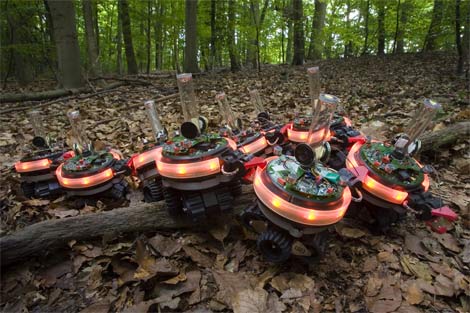
Swarm Robots - Photograph by Peter Essick
Does the thought of a robot swarm scare you? If so, you’re not alone. I’m sometimes asked what I think about the prospect of robots taking over the world, and if I feel I’ve contributed to our inevitable demise.
The answer is no.
People tend to project their fear of other humans onto the humble robot. Let’s not forget that a robot is just a computer – a stupid machine incapable of thought, opinion or prejudice. It might have some wheels and something that resembles appendage, but it’s a stupid machine nonetheless.
People aren’t really afraid of the robot – they’re afraid of which human gets to control the robot.
Sounds like a good reason to learn computer programming, don’t ya think? 
